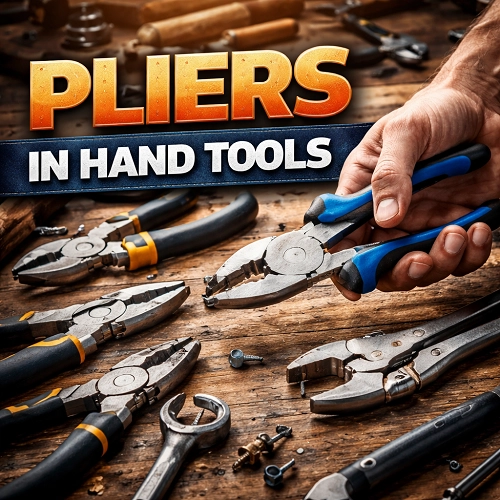
Pliers In Hand Tools are among the most fundamental and widely used hand tools in the world. Whether in a professional workshop, an electrician’s toolkit, or a homeowner’s drawer, pliers provide the grip, leverage, and control needed to hold, bend, cut, and manipulate materials with precision. Their simple design hides a remarkable versatility, making them essential across many trades and everyday tasks.
At their core, pliers are hand-operated tools designed to grip and apply force to objects. They typically consist of two metal arms joined at a pivot point (the fulcrum), with jaws on one end and handles on the other. When the handles are squeezed together, the jaws close, allowing the user to grasp or manipulate an object.
The mechanical advantage provided by the pivot lets users apply far more force at the jaws than they could with their fingers alone. This makes pliers ideal for tasks that require strength, precision, or endurance.
Different jobs require different types of pliers.
These general-purpose pliers have adjustable pivot points, allowing the jaws to open wider or narrower. They are useful for gripping nuts, bolts, wires, and small components.
With long, narrow jaws, these pliers are perfect for reaching into tight spaces, bending wire, or holding small parts in electronics, jewelry making, or electrical work.
Heavier and stronger, these are often used by electricians. They can grip, twist, and cut thick wires and cables.
Also known as wire cutters, these pliers are designed to cut through wire, pins, and small metal rods rather than grip them.
These can be clamped onto an object and locked in place, acting almost like a temporary vice. They are excellent for holding objects securely without continuous hand pressure.
Often used for plumbing, these adjustable pliers are ideal for gripping pipes, fittings, and large nuts.
In DIY and home maintenance, pliers are indispensable for assembling furniture, repairing appliances, and fixing plumbing or electrical issues.
Few tools are as universally useful as pliers. They combine gripping strength, fine control, and mechanical leverage in a compact, easy-to-use form. From delicate electronic repairs to heavy-duty construction work, pliers adapt to countless tasks, making them one of the true cornerstones of hand tools.