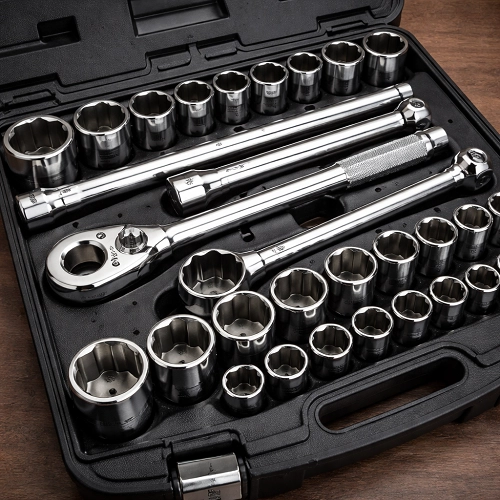
A 3/4-drive socket set is a workhorse in heavy-duty mechanical applications. Whether you’re maintaining industrial equipment, working on large trucks, servicing agricultural machinery, or assembling structural fixtures, this tool delivers the torque and durability you need.
Introduction to Socket Drives
Sockets are among the most versatile hand tools, designed to turn fasteners like nuts and bolts. The drive size refers to the square connection interface between the ratchet (or handle) and the socket.
Common drive sizes include:
- 1/4-inch: Light-duty work
- 3/8-inch: General automotive and household
- 1/2-inch: Moderate automotive and machinery
- 3/4-inch: Heavy-duty applications
- 1-inch: Industrial and high torque scenarios
The larger the drive size, the more torque it can reliably handle.
Understanding 3/4-Drive Socket Sets
Drive Size Comparisons
Compared to smaller drives, a 3/4-inch drive is engineered for situations requiring high torque without resorting to air or electric impact tools. It bridges the gap between everyday hand tool use and industrial power tool demands.
| Drive Size |
Typical Torque Range |
Common Uses |
| 1/2" |
Up to ~150 ft-lbs |
Cars, light trucks, machinery |
| 3/4" |
~150–300+ ft-lbs (hand) |
Heavy trucks, construction |
| 1" |
300+ ft-lbs (hand/impact) |
Industrial/structural assembly |
Typical Socket Sizes
Most 3/4-drive socket sets include a range of large metric and SAE sizes, such as:
- SAE: 7/8", 15/16", 1", 1-1/16", 1-1/8", 1-1/4"
- Metric: 22mm, 24mm, 27mm, 30mm, 32mm, 36mm
These sizes correspond to larger fasteners found on truck axles, heavy hydraulics, and industrial hardware.
Materials and Construction
Quality socket sets are forged from high-strength chrome-molybdenum (Cr-Mo) or chrome-vanadium (Cr-V) alloys. These materials balance tensile strength, impact resistance, and durability.
Many have:
- Black oxide or phosphate finishes for corrosion resistance
- Polished chrome plating for rust protection and easier cleaning
- Magnetic or laser-etched size markings for easy identification
Technical Principles and Torque Characteristics
Torque (a measure of rotational force) is central to socket use:
- Torque = Force × Lever Arm Length
- A 3/4-drive ratchet and appropriate extensions create leverage for stubborn fasteners.
- Over-torquing can stretch or strip threads; under-torquing can lead to fastener failure.
Most professional torque wrenches are calibrated in foot-pounds (ft-lbs) or newton-meters (Nm) and include specifications to ensure accurate fastener tension.
Components of a 3/4-Drive Set
Ratchets
A good 3/4-inch ratchet has:
- 72+ teeth for fine adjustment in tight spaces
- Quick-release button to secure sockets
- Reversible lever for forward/reverse torque
Sockets
Sockets come in:
- Shallow — for standard fasteners
- Deep wells — for extended studs or long bolts
They may also have:
- 6-point geometry — reduces rounding, ideal for heavy torque
- 12-point geometry — easier entry in tight spaces
Extensions and Adapters
- Extensions help reach recessed bolts.
- Universal joints allow angle access.
- Adapters let you convert between drive sizes (e.g., 3/4″ to 1/2″).
Breaker Bars
Non-ratcheting bars provide maximum leverage. Ideal for breaking free frozen hardware before using the ratchet.
Torque Wrenches
Though often separate, torque wrenches compatible with 3/4-drive are crucial when final tightening to spec is required.
Common Use Cases
A 3/4-drive socket set is ideal for:
- Heavy truck and bus suspension work
- Tractor and farm equipment service
- Construction equipment maintenance
- Structural assembly (steel beams, fasteners)
- Marine and industrial settings
Step-by-Step Techniques
Removing a Stuck Fastener
- Select the correct socket — ensure proper size and fit.
- Use a breaker bar — position perpendicular to the fastener.
- Apply steady pressure — avoid jerking movements.
- Use penetrating oil if necessary.
- Switch to ratchet — once loosened.
Tightening to Spec
- Choose a torque wrench rated for your expected range.
- Attach the correct socket and extensions.
- Set torque value per manufacturer specs.
- Slowly apply force until wrench indicates desired torque.
- Re-check critical fasteners after initial load cycles.
Safety Best Practices
- Wear safety glasses and gloves.
- Use tools in good condition — inspect for cracks or worn teeth.
- Avoid “cheater” pipes (additional leverage) on ratchets — use proper breaker bars.
- Know torque specifications — over-torquing can be dangerous.
- Ensure stable footing and clear workspace.
Choosing the Right Tools and Accessories
When building a 3/4-drive toolkit, consider:
- Full set of sockets (both SAE and metric)
- High-tooth-count ratchet
- Quality breaker bar
- Several extension lengths
- Universal joints
- Impact-rated sockets if using with powered tools
Pro-grade cases with foam inserts help organize and protect tools.
Maintenance and Longevity
- Clean sockets after use — wipe off grease and debris.
- Lightly lubricate the ratchet mechanism periodically.
- Store in dry environment to prevent corrosion.
- Replace worn or cracked sockets immediately.
Troubleshooting Tips
- Socket slips off fastener — check for the correct size; consider switching from 12-point to 6-point.
- Fasteners won’t budge — try heat or penetrating oil; use a breaker bar.
- Ratchet skips — inspect and service pawl and gear; consider replacement if worn.
Frequently Asked Questions
Q: Can I use a 3/4-drive socket with an impact wrench?
- A: Only if the sockets and accessories are impact-rated (usually black finish)—standard chrome sockets can shatter under impact use.
Q: Why choose 6-point sockets for heavy work?
- A: 6-point sockets grip flat sides of fasteners, reducing rounding and resisting torque better.
Q: How do I know the torque spec for a fastener?
- A: Consult the equipment’s service manual or torque chart; manufacturers specify torque based on fastener size and grade.
A 3/4-drive socket set is an indispensable resource in any heavy-duty mechanical environment. Armed with the right tools, technical knowledge, and safety practices, you can tackle large fasteners with confidence and precision. Whether loosening a stubborn bolt on a tractor or tightening structural hardware to exacting standards, mastering this toolset elevates both the quality and efficiency of your work.