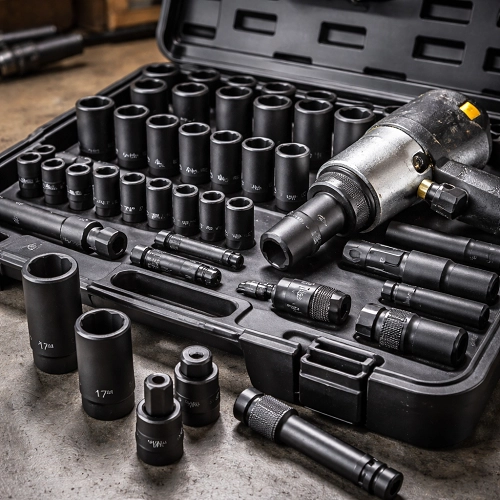
Impact socket sets are indispensable in many mechanical, construction, and maintenance tasks. Unlike standard hand sockets, impact sockets are designed to be used with impact wrenches and drivers — tools that deliver high torque impulses to loosen and tighten fasteners quickly and efficiently.
What is an Impact Socket Hand Tool Set?
An impact socket hand tool set comprises multiple sockets of different sizes and sometimes extensions and universal joints, all specifically engineered to endure the rapid, high-torque vibrations from impact tools.
Components Typically Included
- Impact Sockets: Deep and shallow varieties in SAE (imperial) and metric sizes.
- Extensions: For accessing recessed fasteners.
- Universal Joint Adapters: For angled or difficult-to-reach fasteners.
- Drive Adapters: Convert between drive sizes (e.g., ½″ to ¾″).
Unlike standard sockets (made for hand ratchets), impact sockets are made to handle high torque from impact tools without cracking or shattering.
Why Use Impact Sockets?
Impact sockets are engineered differently than regular sockets to withstand the stresses of impact tools.
Technical Characteristics
Material & Heat Treatment
- Made from alloy steel, often chrome molybdenum (Cr-Mo).
- Heat-treated for toughness (ability to deform under shock rather than snap).
Surface Finish
Typically black phosphate or black oxide finish.
- This enhances corrosion resistance and prevents glare.
- Reduces the chance of brittle failure.
Thickness
- Walls are thicker than on standard sockets.
- This extra mass absorbs shock and reduces cracking.
Design for Deformation
- Under high torque, impact sockets will slightly deform and flex, which is better than brittle failure.
Choosing the Right Impact Socket Set
When evaluating sets, consider these key factors:
Drive Size
This is the square connection size where sockets attach to your tool.
- ¼″ Drive – Light bolts, smaller assemblies.
- ⅜″ Drive – Most automotive and general mechanical work.
- ½″ Drive – Heavy automotive, trucks, suspension components.
- ¾″ & 1″ Drives – Heavy industry, commercial trucks, construction.
Match the drive to your impact tool and expected torque loads.
Socket Material & Standards
Look for:
- Chrome-molybdenum steel (Cr-Mo) – stronger and safer with impact tools.
- ANSI/ASME standards compliance – ensures correctness of dimensions.
Avoid:
- Chrome-vanadium (Cr-V) plated sockets for impact use — these are brittle and can fail.
Sizes Included
- A broad size range means more versatility.
- Common metric sizes: 8mm–24mm (or bigger).
- Common SAE sizes: 5/16″–1″ (and larger in heavy sets).
Using an Impact Socket Set — Step by Step
Setting up the Tool
Choose the correct socket size.
- It should fit snugly onto the bolt or nut — not loose.
- Avoid forcing a socket one size off.
Attach to the Impact Tool
- Line up the socket’s square hole with the impact tool’s anvil.
- Ensure the detent pin on the tool engages the socket’s groove.
Choosing the Direction
- Most impact tools have a forward/reverse switch.
- Counter-clockwise for loosening.
- Clockwise for tightening.
Apply Controlled Force
Unlike hand ratchets, impact tools don’t require your full effort — they do the work through rapid hammering action.
- Let the tool spin and torque the fastener.
- Avoid jerking or pre-loading — the impact mechanism absorbs most stress.
Step-By-Step Torque Control
- Loosening: Start in reverse and give short bursts.
- Removing: Once free, remove by hand.
- Tightening: Use short bursts until snug.
- Final Torque: If precision torque is required, finish with a torque wrench (see below).
Torque and Precision: When to Use What
Impact Tools vs Torque Wrenches
- Impact tools are fantastic for speed and raw torque.
- Torque wrenches are essential for precision tightening.
Why? Impact tools can easily exceed specified torque values. Automotive components (e.g., engine head bolts, suspension fasteners) almost always require a specific torque.
Best Practice:
- Use impact tool to snug.
- Finish and verify torque with a torque wrench.
Safety: Top Priority With High-Torque Tools
Impact sockets handle heavy forces — but you, the user, must handle safety.
Key Safety Practices
- Wear eye protection. Flying debris or sudden fastener failure can cause injury.
- Gloves: Protect hands from pinch points and vibration.
- Inspect sockets: Remove cracked or damaged sockets immediately.
- Clear area: Ensure no one is in the path of moving parts.
- Keep grip firm: High torque can twist an unsecured grip.
Care and Maintenance of Impact Sockets
A well-maintained set lasts decades.
General Tips
- Clean after use: Wipe sockets to remove oil, dirt, grit.
- Lubricate occasionally: Light coating of rust inhibitor.
- Store properly: Organize in trays/cases to prevent loss and damage.
Inspect for Wear
- Check for burrs or rounding on drive or fastener faces.
- Replace sockets that show deformation.
Advanced Techniques & Common Applications
Automotive Repair
- Suspension components.
- Lug nuts.
- Engine assemblies.
Construction Equipment
- Structural bolts and anchor bolts.
- Heavy steel assembly.
Agricultural and Heavy Machinery
- Farm implement maintenance.
- Tractor bolts and pins.
Assembly Line Work
- Production environments use impact tools for speed and repeatability.
Comparing Impact Sockets with Standard Sockets
| Feature |
Impact Socket |
Standard Socket |
| Material |
Alloy steel Cr-Mo |
Chrome-Vanadium |
| Wall Thickness |
Thick |
Thin |
| Use |
Impact tools |
Hand ratchets |
| Torque Tolerance |
Very high |
Moderate |
| Surface Finish |
Black oxide/phosphate |
Chrome plated |
| Safety |
Lower breakage risk under impact |
Higher breakage risk with impact |
Common Mistakes and How to Avoid Them
Using Standard Sockets on an Impact Tool
- Why it’s bad: High torque will crack or shatter standard sockets.
- Fix: Only use sockets rated for impact.
Over-Tightening
- Problem: Stripping threads or damaging components.
- Solution: Always verify with a torque wrench.
Improper Socket Fit
- Risk: Rounding fastener corners.
- Solution: Match size exactly; avoid forcing slightly wrong sizes.
Choosing the Best Set for You
Here’s how to narrow your choice:
For DIY Enthusiasts
- ⅜″ and ½″ drive set.
- Broad midrange sizes (10–19 mm or 3/8″–3/4″).
- Extensions included.
For Automotive Technicians
- Comprehensive ½″ drive.
- Deep sockets for recessed fasteners.
- Universal joints and adapters.
For Heavy Duty / Industrial
- Add ¾″ or 1″ drive options.
- Extra-heavy sockets and longer extensions.
Future Trends & Innovations
Impact sockets and power tools continue evolving:
- Improved alloys and heat treatments for strength and weight reduction.
- Digital torque-control impact guns that blend speed with precision.
- Modular storage systems for better organization.
As tools improve, safety and productivity improve too.
An impact socket hand tool set is a foundational investment for anyone working with fasteners. Understanding the components, proper use, safety practices, and the difference between impact and standard sockets ensures you get the most from your tools — safely and efficiently.