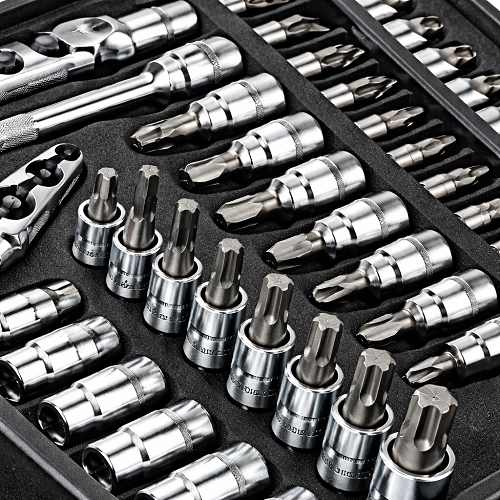
A Bit Socket Hand Tool Set is a versatile hybrid between traditional socket tools and interchangeable driver bits. Designed to bridge the gap between hex-bit drivers and ratcheting socket systems, these sets are widely used in automotive repair, industrial maintenance, electronics, construction, and precision mechanical work. Despite their apparent simplicity, bit socket sets involve a range of technical considerations—materials science, torque transmission, dimensional standards, wear mechanisms, and ergonomic design—that directly affect performance, safety, and longevity.
What Is a Bit Socket Hand Tool Set?
A Bit Socket Hand Tool Set consists of:
- Bit sockets: Socket bodies with permanently integrated or replaceable bits.
- Drive interfaces: Typically 1/4", 3/8", or 1/2" square drives.
- Bit profiles: Phillips, slotted, Torx®, hex (Allen), Pozidriv, spline, Robertson, security variants, and specialty profiles.
- Accessories: Extensions, adapters, universal joints, and sometimes torque-limiting handles.
Unlike standard screwdriver bits that rely on axial force from the user, bit sockets are designed to transmit torque via a ratchet or breaker bar, allowing for higher torque capacity and more consistent engagement.
Materials and Metallurgy
Socket Body Materials
Most socket bodies are manufactured from:
- Chrome Vanadium Steel (Cr-V): Balances toughness, strength, and corrosion resistance.
- Chrome Molybdenum Steel (Cr-Mo): Common in impact-rated bit sockets due to higher fatigue and shock resistance.
Bit Materials
Bits are typically made from:
- S2 Tool Steel: Offers superior torsional strength and wear resistance.
- Proprietary alloys: Heat-treated blends optimized for specific torque ranges or impact use.
Heat Treatment
Critical processes include:
- Quenching and tempering to achieve hardness without brittleness.
- Differential heat treatment, where the bit tip is harder than the shank to reduce tip rounding while allowing controlled torsional flex.
Improper heat treatment can result in brittle fracture or premature wear.
Dimensional and Drive Standards
Drive Sizes
Common square drives include:
- 1/4": Light-duty, precision, electronics, and small fasteners.
- 3/8": General-purpose mechanical and automotive use.
- 1/2": Heavy-duty, structural, and industrial applications.
Bit Standards
- Hex bits: Metric (ISO) and SAE (ASME) dimensions must not be mixed.
- Security bits: Must meet exact tolerances to avoid fastener damage.
Tolerance stacking between socket body, bit interface, and fastener geometry can significantly affect torque transfer efficiency.
Torque Transmission and Mechanical Performance
Torque Capacity
Bit sockets generally handle higher torque than loose bits due to:
- Reduced axial slip
- Improved alignment with the fastener
- Stronger bit retention mechanisms
However, torque limits are still governed by:
- Bit cross-sectional area
- Material yield strength
- Fastener head design
Impact vs Hand Use
Impact-rated bit sockets are engineered with:
- Thicker walls
- Cr-Mo steel
- Controlled torsional flex
Using non-impact bit sockets with impact tools can result in catastrophic failure.
Ergonomics and Accessibility
Low-Profile Designs
Low-profile bit sockets allow access in confined spaces but may sacrifice torque capacity due to reduced material cross-section.
Length Variations
- Short sockets: Better control and reduced flex.
- Long sockets: Improved reach but increased torsional deflection.
Ratchet Compatibility
Fine-tooth ratchets (72–120 teeth) complement bit sockets in tight spaces by requiring minimal swing arc.
Applications Across Industries
Automotive and Powersports
- Interior trim fasteners
- Brake and sensor components
Industrial Maintenance
- Machine guarding
- Control panels
- Conveyor and equipment assemblies
Electronics and Precision Work
- Security fasteners
- Low-torque assemblies
- Anti-tamper designs
Construction and Fabrication
- Structural connectors
- Specialty fasteners
- Modular hardware systems
Common Failure Modes
Bit Tip Rounding
Caused by:
- Excessive torque
- Poor material quality
- Misaligned engagement
Socket Cracking
Often due to:
- Using hand-rated sockets with impact tools
- Material defects or improper heat treatment
Retention Failures
Weak detent balls or magnets can lead to bit loss, especially in overhead work.
Maintenance and Longevity
- Regular cleaning to remove metal debris and oils
- Inspection for micro-cracks, rounding, or discoloration (overheating)
- Proper storage to prevent corrosion and misplacement
- Torque discipline—use torque wrenches where specifications matter
Proper care can extend the life of a professional-grade bit socket set by years.
Safety Considerations
- Always match the bit type and size exactly to the fastener.
- Never exceed manufacturer torque ratings.
- Wear eye protection—bit fracture under load can produce high-velocity fragments.
- Avoid mixing metric and SAE fasteners and bits.
The Bit Socket Hand Tool Set is far more than a convenience accessory—it is a precision torque transmission system shaped by metallurgy, geometry, and mechanical engineering. Selecting the right set requires understanding drive standards, material properties, torque demands, and application-specific risks. When properly chosen and maintained, a high-quality bit socket set delivers superior efficiency, reduced fastener damage, and enhanced safety across a wide range of technical disciplines.