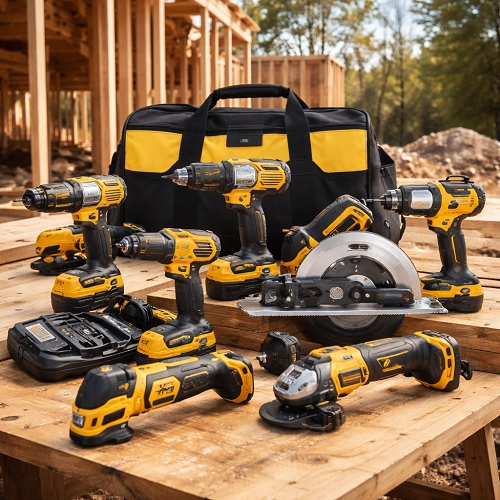
Cordless power tool sets have transformed how professionals and DIYers approach construction, remodeling, repair, and creative projects. They offer mobility, convenience, and increasingly impressive performance as battery and motor technologies evolve.
1. What Are Cordless Power Tool Sets?
A cordless power tool set is a collection of battery-powered tools designed to work together within a shared platform—typically a common battery and charger system. These sets often include essential tools like a drill/driver, impact driver, circular saw, reciprocating saw, flashlight, and more. They are sold as bundles to offer value and ensure compatibility across tools.
Unlike corded tools that require AC power from outlets, cordless tools run on rechargeable batteries, offering:
- Freedom of movement
- No extension cords
- Safety on elevated or remote sites
- Compact, ergonomic operation
2. Core Components of a Cordless Tool Set
A. Tools
The composition varies by set but commonly includes:
- Drill/Driver: For drilling holes and driving screws.
- Impact Driver: High torque for driving fasteners.
- Circular Saw: Portable cutting of wood and sheet goods.
- Reciprocating Saw: Demolition and rough cuts.
- Oscillating Multi-Tool: Sanding, cutting, scraping.
- Flashlight or Work Light: On-site illumination.
- Angle Grinder: Grinding, cutting, finishing metal and masonry.
Professional sets may also include specialty tools (jigsaws, rotary hammers, polishers).
3. Battery Technology
The heart of cordless tools is the battery. Lithium-ion (Li-ion) chemistry dominates the market for its high energy density, low self-discharge, and long life compared to older NiCd or NiMH batteries.
A. Voltage Ratings
Battery voltage is a key performance metric:
- 12 V–18 V: Compact tools, lighter weight, good for general home use.
- 18 V–20 V: Industry standard for most construction and renovation tasks.
- 24 V–60 V: Heavy-duty tools like miter saws and larger saws.
Note: Some manufacturers use “18 V” and “20 V” labels loosely; an 18 V battery under load can be rated as 20 V max (measured before load).
B. Ampere-Hours (Ah)
Capacity in Ah determines how long a battery runs between charges:
- 2.0–3.0 Ah: Light, good for everyday tasks.
- 4.0–6.0 Ah: Balance of runtime and size.
- 8.0 Ah+: Extended runtime for heavy use.
Runtime ≈ Capacity / Current Draw (varies by tool and task).
C. Cell Configuration
Li-ion cells are arranged in series/parallel to reach desired voltage and capacity. Higher quality cells improve heat management and longevity.
D. Battery Management Systems (BMS)
Modern batteries include BMS electronics that:
- Prevent overcharge/over-discharge
- Balance cell voltage
- Protect against temperature extremes
4. Brushless vs. Brushed Motors
Most contemporary cordless tools use brushless motors, which are electronically commutated and offer key advantages:
| Feature |
Brushless |
Brushed |
| Efficiency |
Higher |
Lower |
| Runtime |
Longer |
Shorter |
| Heat Generation |
Lower |
Higher |
| Maintenance |
None |
Brushes wear out |
| Cost |
Higher |
Lower |
Brushless motors optimize torque and battery life by adjusting power dynamically through onboard electronics.
5. Charger and Charging Technology
Charging speed and battery longevity depend on charger design:
- Standard Chargers: Moderate speed, gentle on batteries.
- Fast Chargers: Reduce charge time with higher current.
- Multi-Port Chargers: Recharge multiple batteries simultaneously.
- Smart Chargers: Diagnose battery health, cool/heat control, and balance cells.
Charging time varies by capacity and charger rating, e.g., 2 Ah packs may charge in ~30–45 min, while 6 Ah packs may take 60–90 min.
6. Compatibility and Ecosystems
A major consideration is tool/battery ecosystem:
- Single Platform Advantage: One battery fits many tools.
- Cross-Compatibility: Some brands allow older batteries with adapters, or newer batteries on older tools.
- Accessory Integration: Shared chargers, lights, fans, inflators, outdoor equipment.
Popular ecosystems include major brands like DeWalt, Makita, Milwaukee, Bosch, Ryobi, and others.
7. Performance Metrics
When evaluating cordless tools, look at:
- Torque (Nm or in-lb): For drills and impact drivers.
- No-Load Speed (RPM): Indicates potential cutting or drilling speed.
- Blows Per Minute (BPM): For impact tools and hammers.
- Cut Capacity: For saws (depth/width of cut).
- Weight: Affects fatigue and control.
Performance also depends on the battery’s state of charge and the tool’s load conditions.
8. Safety and Ergonomics
A. Safety Features
- Electric brakes: Quickly stop tool motion.
- Clutch systems: Prevent over-torquing screws/fasteners.
- Lock-off switches: Prevent accidental starts.
- Kickback control: Reduces reactive torque in saws.
B. Ergonomic Design
- Grip texture and shape
- Balanced weight distribution
- Compact form factors for confined spaces
9. Pros and Cons of Cordless Sets
Advantages
- Mobility without cords
- Reduced setup and cleanup time
- Safer on sites without good power access
- More tools available as batteries improve
Limitations
- Limited runtime compared to corded tools (requires spare batteries)
- Higher upfront cost
- Battery degradation over time
- Performance may lag for very high-power tasks
10. How to Choose a Cordless Power Tool Set
A. Assess Your Needs
- DIY homeowner: Basic drill/driver, impact driver, compact saw.
- Renovator: Mid-range battery (4.0–5.0 Ah), circular saw, reciprocating saw, oscillating tool.
- Pro/Contractor: Brushless tools, multiple high-capacity batteries, rapid charger, dust extractors.
B. Consider Brand Ecosystem
- Long-term support: Warranty, battery price, availability.
- Ecosystem breadth: Tools you’ll eventually want.
C. Battery Strategy
- Buy at least two batteries per voltage platform.
- Plan for one charging while one in use.
D. Check Warranty and Service
Good warranties and accessible service centers can add value.
11. Accessories and Add-Ons
- Drill bit and driver bit sets
- Saw blades (wood, metal, specialty)
- Tool bags and carts
- Battery holsters and organizers
- Work lights and site radios
12. Future Trends in Cordless Tools
Cordless technology continues to evolve:
- Higher voltage platforms for heavier tools
- Faster charging (supercharger tech)
- Integrated smart features (Bluetooth, tool tracking, performance analytics)
- Improved energy density batteries (solid state, new chemistries)
- Electric outdoor power equipment joining tool ecosystems
Cordless power tool sets offer unmatched flexibility, making them indispensable for modern builders, contractors, and hobbyists. Understanding battery technologies, motor types, tool performance, and ecosystem compatibility will help you select the right set that balances power, runtime, and cost for your unique needs.